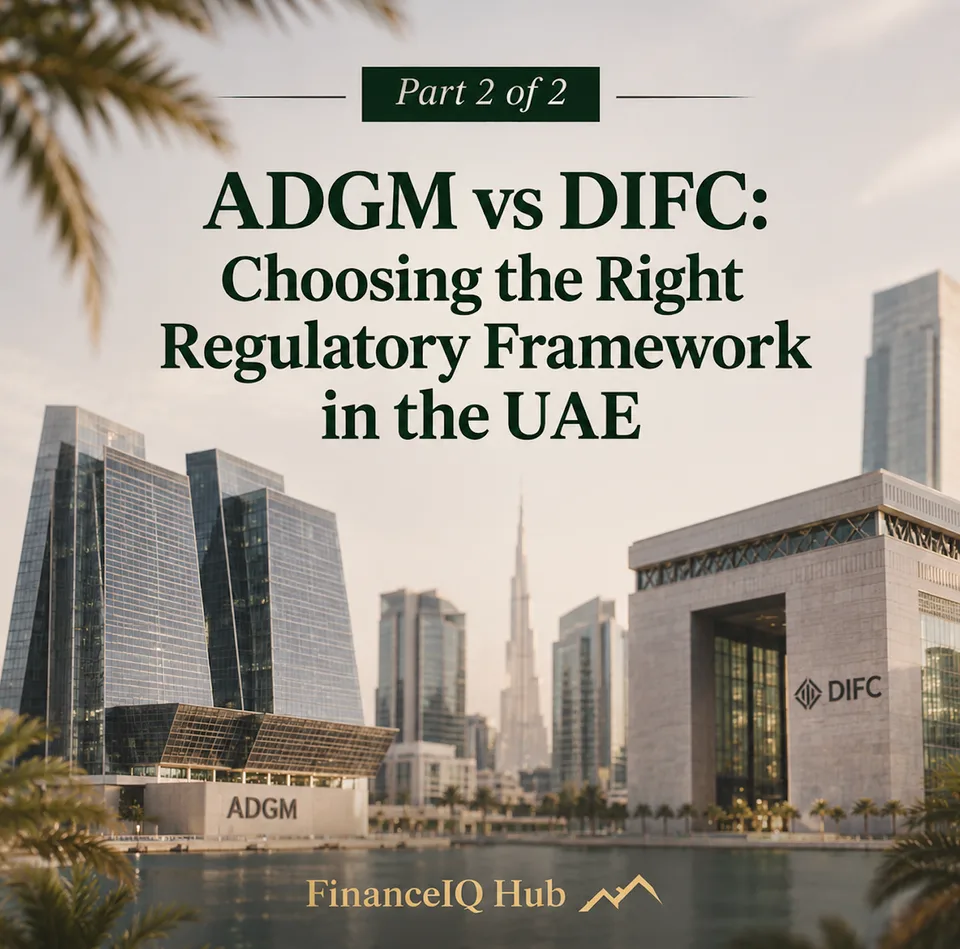
ADGM vs DIFC: Choosing the Right Regulatory Framework for Digital Asset Businesses in the UAE
Part 2
In the first part of our legal review, we examined the responsibilities of the Central Bank of the UAE (CBUAE) and Dubai's Virtual Assets Regulatory Authority (VARA).
However, the UAE regulatory landscape extends beyond these authorities.
Two major international financial centres play an important role in the regulation of financial services and digital assets: Abu Dhabi Global Market (ADGM) and Dubai International Financial Centre (DIFC).
Both operate under their own legal frameworks, financial regulators and specific requirements for digital asset activities.
1. ADGM — Digital Asset Regulation in Abu Dhabi's International Financial Centre
Abu Dhabi Global Market is a financial free zone where financial services are supervised by the Financial Services Regulatory Authority (FSRA).
Unlike VARA, which operates a specialised licensing framework for virtual asset service providers, ADGM integrates digital asset activities into its broader financial services regulatory system.
Companies conducting regulated financial activities must obtain a Financial Services Permission (FSP).
Depending on the business model and characteristics of the assets involved, regulated activities may include:
- Virtual asset exchange and trading;
- Brokerage and intermediary services;
- Custodial services;
- Investment management;
- Trading platform operations;
- Activities involving tokenised financial instruments.
An important feature of the ADGM framework is the distinction between virtual assets, digital securities and Fiat-Referenced Tokens (FRTs).
Stablecoin Regulation in 2026
Updated FSRA rules governing Fiat-Referenced Tokens came into effect on 1 January 2026.
These rules establish specific requirements relating to relevant issuers, reserve assets, redemption mechanisms and the use of such tokens by regulated financial institutions.
The framework also introduces the concept of Accepted FRTs, establishing criteria for determining which tokens may be used by authorised firms.
ADGM may therefore provide a suitable regulatory environment for institutional trading platforms, investment structures and businesses combining traditional financial services with digital assets.
However, the specific permissions required depend on the company's actual activities, product structure and target customer categories.
2. DIFC — Dubai's Independent Financial Jurisdiction
The Dubai International Financial Centre (DIFC) is an international financial centre operating under its own legal and regulatory framework.
Financial services within DIFC are supervised by the Dubai Financial Services Authority (DFSA).
Although DIFC is geographically located in Dubai, companies conducting regulated financial activities within the centre fall under DFSA supervision rather than VARA.
The DFSA regulates financial services involving Crypto Tokens and Investment Tokens, taking into account the legal characteristics of the relevant assets.
Regulated activities may include brokerage, asset management, custody, investment services and other financial activities.
Changes to the Crypto Token Framework
Updated DFSA rules governing Crypto Tokens came into effect on 12 January 2026.
One of the most significant changes was the transition away from a regulator-maintained list of Recognised Crypto Tokens towards a framework in which authorised financial firms are responsible for assessing token suitability against regulatory criteria.
Companies must now conduct and document their assessments, considering factors such as asset characteristics, liquidity, technological risks and other relevant considerations.
This approach provides greater flexibility while increasing the responsibility of financial institutions to maintain effective internal controls.
DIFC may be particularly attractive to investment firms, financial intermediaries and businesses planning to operate with tokenised financial instruments.
3. Can a Company Be Subject to Multiple Regulatory Frameworks?
Yes. The UAE's regulatory frameworks are not necessarily mutually exclusive.
For example, a company may provide digital asset exchange services while also using payment tokens to facilitate customer settlements. In such circumstances, it is necessary to determine whether all activities are covered by a single authorisation or whether certain functions require additional regulatory approval.
Companies must also consider the territorial scope of their licences, the legal classification of assets, customer locations and actual control over customer funds.
Federal capital markets regulation is another important consideration, including the responsibilities of the Capital Market Authority (CMA) in relation to certain financial services and virtual asset activities.
Therefore, jurisdiction selection should not be limited to a comparison of VARA, ADGM and DIFC alone.
4. How to Choose the Right Jurisdiction
Before incorporating a company, businesses should consider conducting a Regulatory Perimeter Assessment — a legal analysis designed to determine which regulatory requirements apply to the proposed activities.
This assessment should establish:
- Which services the company intends to provide;
- Whether it will control or safeguard customer assets;
- Which categories of digital assets will be supported;
- Whether fiat payments or payment tokens will be involved;
- Where customers will be located;
- Which financial licences, permissions or regulatory approvals are required.
For example, a custodial digital asset exchange operating in Dubai may begin its regulatory assessment with VARA.
An institutional trading platform or investment structure may consider the ADGM framework.
A company intending to provide investment services or work with tokenised financial instruments may evaluate DIFC as a potential jurisdiction.
However, no single jurisdiction is universally suitable for every fintech business. The final decision must reflect the company's specific activities and applicable legal requirements.
Conclusion
The UAE offers a sophisticated regulatory environment for international fintech businesses, but its licensing regimes are not interchangeable.
CBUAE supervises relevant payment services and payment tokens.
VARA provides specialised regulation of virtual asset activities in Dubai, excluding DIFC.
ADGM / FSRA offers a comprehensive financial services framework covering virtual assets and certain categories of stablecoins.
DIFC / DFSA regulates financial and investment services, including activities involving specified categories of digital tokens.
For international businesses, selecting the correct regulatory framework is not only a matter of legal compliance. It also affects access to banking services, relationships with financial partners, customer asset management and future business expansion.
This article reflects information available at publication. Requirements may change; confirm current rules with the relevant regulator before acting.